

UX Content Collective

Issue 01
The Dash brings you the best content design news, articles, and resources from around the web.
Dash+ goes further. We do the research and reporting ourselves. Original industry analysis, exclusive insights from practitioners, and real data on hiring, salaries, and the skills employers want.
It's information you can use to make better decisions about your work and career.
Your first issue is free. After that, Dash+ is exclusive to UXCC members.
 Lead columnAnalysis and opinion01
Content design is winning a big argument right now, but that might not be enough
Content design is more established than it was a decade ago. But have we actually gained more influence over the decisions that shape products?
 Patrick Stafford
CEO, UX Content Collective
Head to LinkedIn, Reddit, or really any online forum, and you'll see the same message over and over again: the job market is terrible.
I think that's pretty obviously true. Multiple interview rounds are back in vogue (I’ve heard tell of double digits) and according to Greenhouse's 2026 hiring report, the average number of applications per job more than doubled between 2022 and 2025, from 116 to 244.
But I want to back up a second and take a longer-term view, because I think we're at risk of confusing a terrible hiring market with a profession in decline.
I don't have reliable figures comparing the number of content design jobs in 2016 with today. But look at how much has changed.
We have a popular conference dedicated to content design (Button). Content designers speak at some of the industry's biggest events, including Config. In 2016, GOV.UK had around 30 content designers. By 2025, that number had grown to 70. And in January 2023, LinkedIn ranked Content Designer as the 12th-fastest-growing job title in the United States over the preceding five years.
We've established dedicated teams, leadership positions, and career paths that were far less common a decade ago. More people have entered the profession, and more organizations understand what content designers actually do.
With the COVID hiring boom, it’s hardly surprising that a larger pool of experienced professionals competing for fewer openings made finding work more difficult.
Small comfort to anyone looking for a job right now, I know. But there's another cause for optimism. Turns out writing well is really hard. Really, really hard.
Earlier this year, Anthropic advertised a Head of Copy & Content position paying up to US $400,000. That's a brand and editorial leadership role, not a product content design job, but still.
And speaking of Anthropic, CEO Dario Amodei said he uses Claude to brainstorm and develop ideas for his essays, but doesn't let it write the finished text.
"We're not quite there yet," he said. Pretty odd for a tool with a focus on writing. It seems coding has eclipsed prose as the main proof of AI's dominance.
In any case, companies already know how hard it is to write well. They need structured information, content governance, clear rules about system behavior, and ways to evaluate the quality of what their models produce. Content designers been talking about these things for years! Decades, even!
So when we hear people saying things like "writing is harder than we thought" it can make us feel vindicated.
But we need to be careful what we call progress, because recognition isn't the same as influence.
Recognition isn't the same as influence.
Consider a content designer who's asked to evaluate thousands of AI responses against criteria someone else has established. They might spend their days working in spreadsheets, writing example responses, and identifying failures.
That's complex work, and it can be valuable. But can they challenge the criteria? Can they change the system, or merely report that it failed?
Now contrast that with someone who establishes terminology, content models, or evaluation standards that shape hundreds of product decisions without their direct involvement.
The second person might write considerably less. They might even spend less time working directly with AI. But they have more power.
A company can employ dozens of content designers and still treat them as a service.
Another company might employ just a handful of specialists whose work determines how content is structured, managed, and evaluated across the entire product.
I’m hearing more and more from content designers who are doing awesome, incredible things with AI tools. They’re building skills that show up at the point of design, they’re changing content in repos, they’re making Figma plugins that scan frames for vocab accuracy.
It’s very, very easy to mistake building these types of tools with progress just because they make life easy and get good results. Okay, great, your content is accurate. That should have been the case anyway. It doesn’t change how people within your organization actually view content.
That over anything else is going to make the difference between whether content is valued as an initiative. Not how many widgets you build or how many tokens you spend building something cool.
There’s this question that keeps popping up: “if we can just create content skills or tools, can’t they just replace us?”
As the kids say, I’m going to hold your hand when I say this: if your company gets rid of content design because someone built a Claude skill, they weren't going to keep you around for much longer anyway. If they’re thinking that way, they don’t respect content in the first place, and a lack of automation wasn’t going to keep you there.
If your job is becoming more technical, and you’re getting more control over content from end-to-end, then that’s great. But there's not much point celebrating how much more we can do if you still have no say in what gets done. Let that, over anything else, be your guide.
 People & TeamsMoves, openings and chatter02
A few interesting moves, opportunities, and other bits of industry chatter we've spotted lately.

One for the newer UX writers. Dash+ isn't going to become a job board, but every so often we'll flag something worth a look. Here's one: American Express is hiring a UX Writer Associate, and Janet Choi, its Director of Content Design, explicitly says it's "a great opportunity for someone newish to content design."

Want a glimpse of the future? IBM Canada is hiring a Content Design Intern to work on IBM Bob, its AI coding partner. More content design internships? Love that. But check out the responsibilities: writing and maintaining tech docs, working in a code repo, making content structure decisions, writing and reviewing UI copy, and building AI-assisted documentation workflows. If you want a glimpse of where content design roles are heading, this is a pretty interesting signpost.

Layoffs, and a little lesson in terminology. Netflix announced another round of cuts this week, affecting around 1,000 employees. Not sure if any content designers are among them. Any news from the inside? Let us know.
The train's leaving the Meta station. It's been an interesting few months for the Meta alumni network. Ali Horowitz has joined Humana as a Senior Content Designer, Anne Lowrey has joined Expedia as a Content Designer, and Megan Monserez has landed at Google as a Senior Content Designer. And Victor Beigelman has left Meta after nine years - he made a splash last year with a blog asking whether content design's problems are our own making.
Practitioner spotlightWork from people in the field03Want your work featured here? Email us at info@uxcontent.com.
Casey's Figma plugin
 Casey Webb
Senior Content Designer, Snap Finance
I wanted to create a content library so designers wouldn’t have to manually search for strings in design files, so I started building a Figma plugin.
Using Claude Code, I built a plugin that scanned Figma frames and sent content to Airtable. As I learned, the plugin evolved, adding search, audits, and other experiments like dynamic content and variables. Seeing the idea become something tangible was incredibly rewarding.
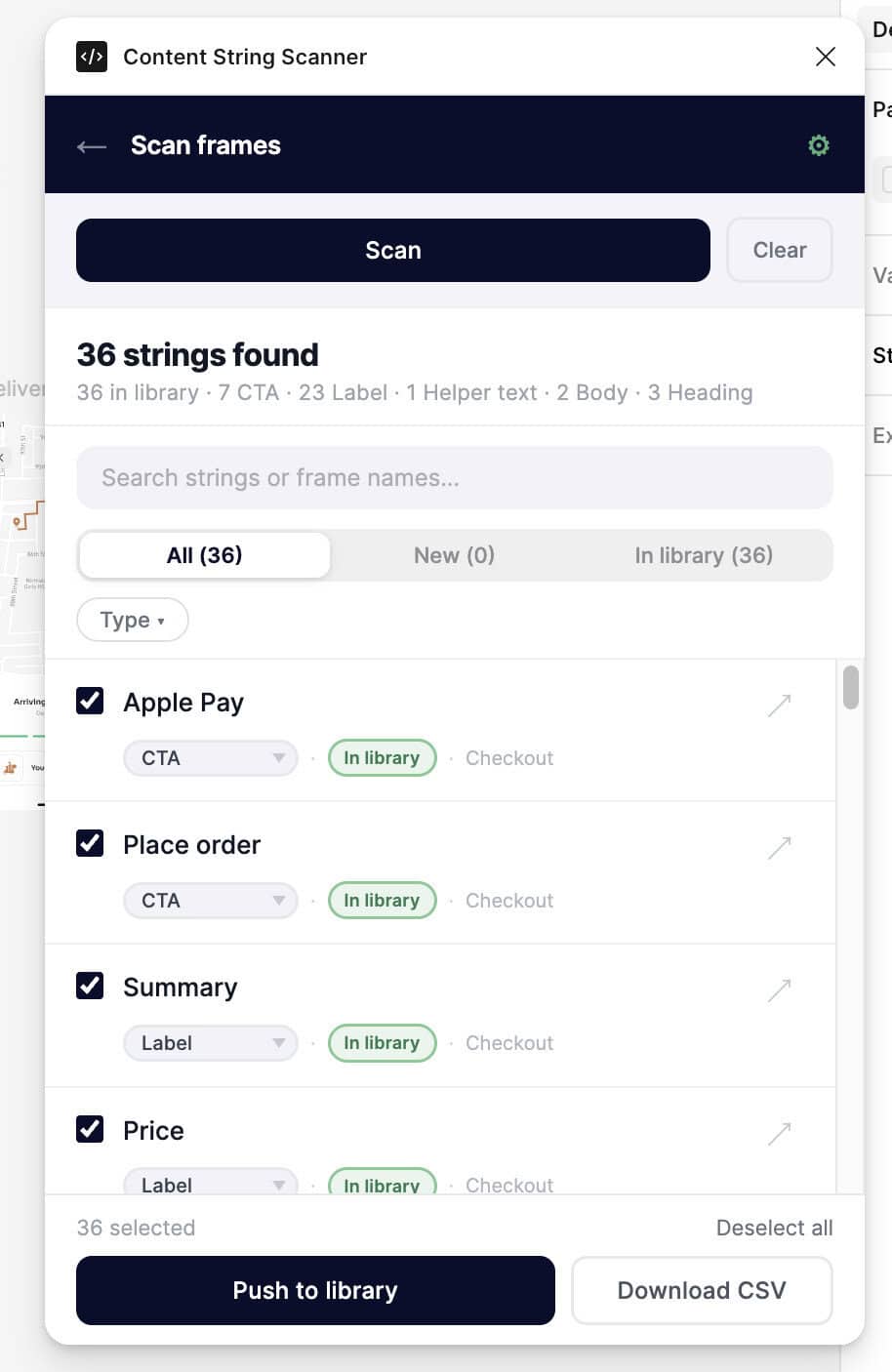
But as the content designer supporting our consumer UX space, I want to build systems that go beyond me. That shifted my focus from “Can I build this?” to “How do we maintain and scale it?” One challenge was figuring out how to make the scanning logic more accurate without hard-coding every rule into the plugin. I started experimenting with moving those rules into Airtable so others could update them without needing to touch the code.
Over time, my conversations and experiments pointed toward a simpler model: rather than everything living inside a plugin, the real value could be having a solid content library that people can access through tools they already use daily.
I think what was most exciting about this process was realizing that building something can reveal a bigger opportunity than the one you started with. I was able to make an idea tangible before I had all the answers.
 Inside the Job Market · October 2026Monthly job-ad research04
Inside the Job Market: What 31 content design job ads actually asked for
Dash+ original research · October 2026 · United States
Everyone has an opinion about what content designers need to know right now. So we decided to see what employers are actually asking for.
For our first monthly study, we examined 31 product content design, UX writing, content strategy, and conversation/model design advertisements from 22 employers, first posted between September 15 and October 14, 2026.
A caveat: this is just a snapshot, not a representative survey of US hiring.
1. What are employers actually asking for?
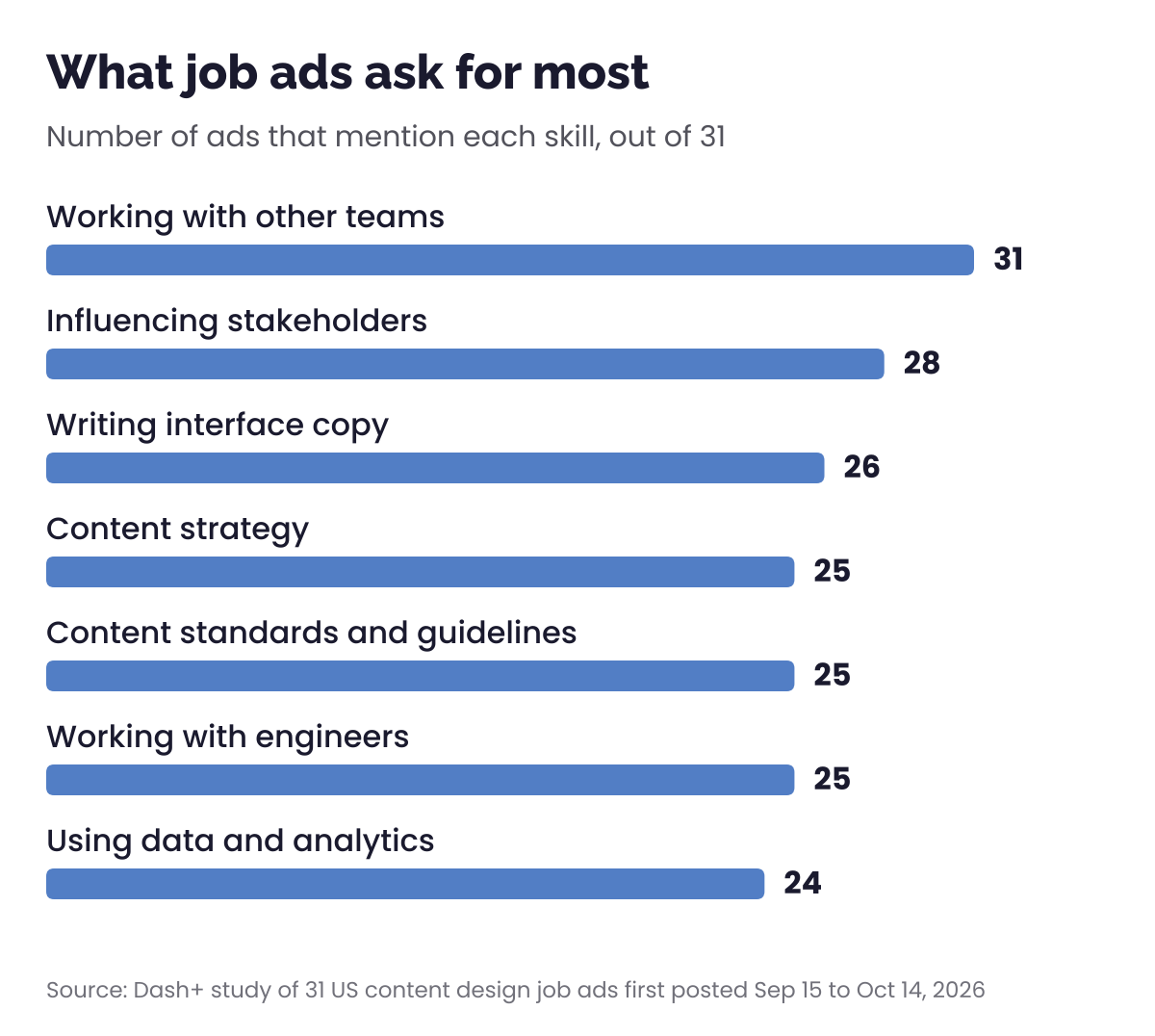
UX/interface writing appears in 26 ads (84%) and appears in required-qualification sections in 19 (61%), sometimes as one of several acceptable backgrounds. Content strategy and governance each appear in 25; analytics in 24. But come on, it's an assumed standard. Basic stuff.
2. What does “AI” actually mean in these ads?
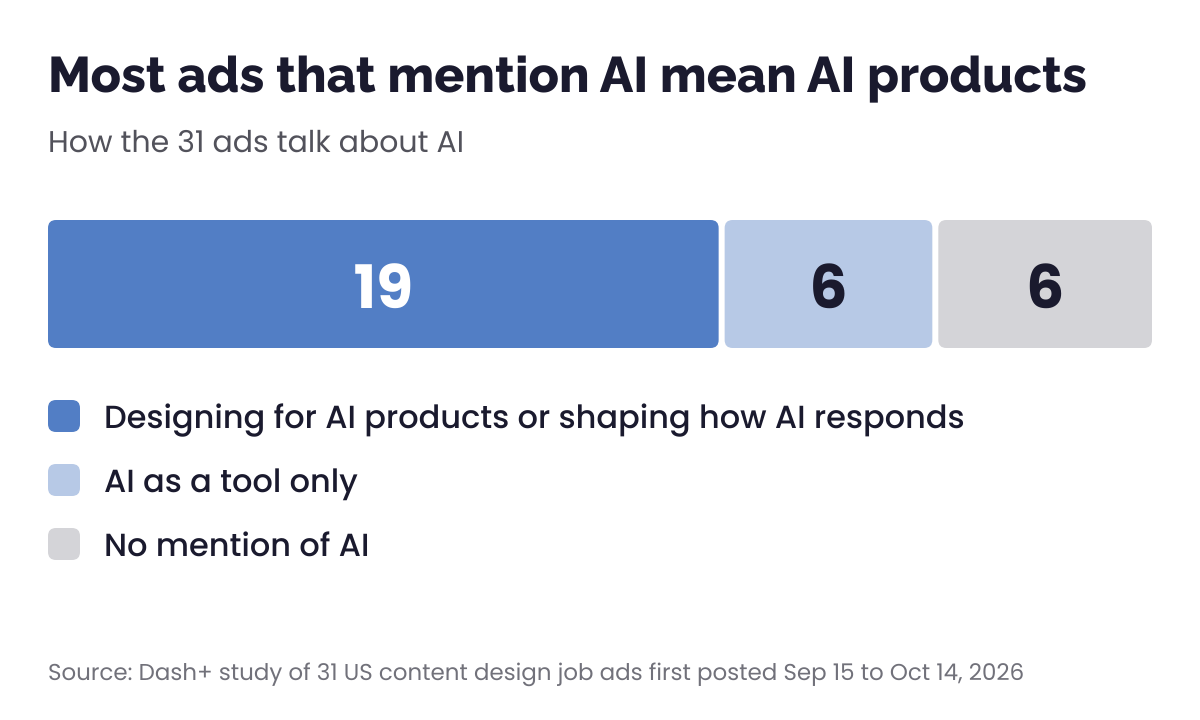
Twenty-five of 31 ads mention AI. But not all of those references mean the same thing.
- 16 involve content or conversation design for AI products.
- 13 involve model behavior, system instructions, prompts, or evaluation.
- 10 specifically mention evaluation rubrics or datasets.
- 6 mention only using AI tools or general AI literacy, without the more specialized AI-product work.
So in this sample, AI is more often something the person will help design or evaluate than just a tool they'll use to write faster.
The actual responsibilities make the distinction clear. Capital One's Senior Manager, Content Design role includes creating “golden dialogues” for an AI agent's customer-service conversations. Airbnb's Staff UX Writer, AI is asked to help set the quality bar for AI-generated content, write reference examples, and grade model outputs.
3. Model-behavior roles describe a different mix of skills
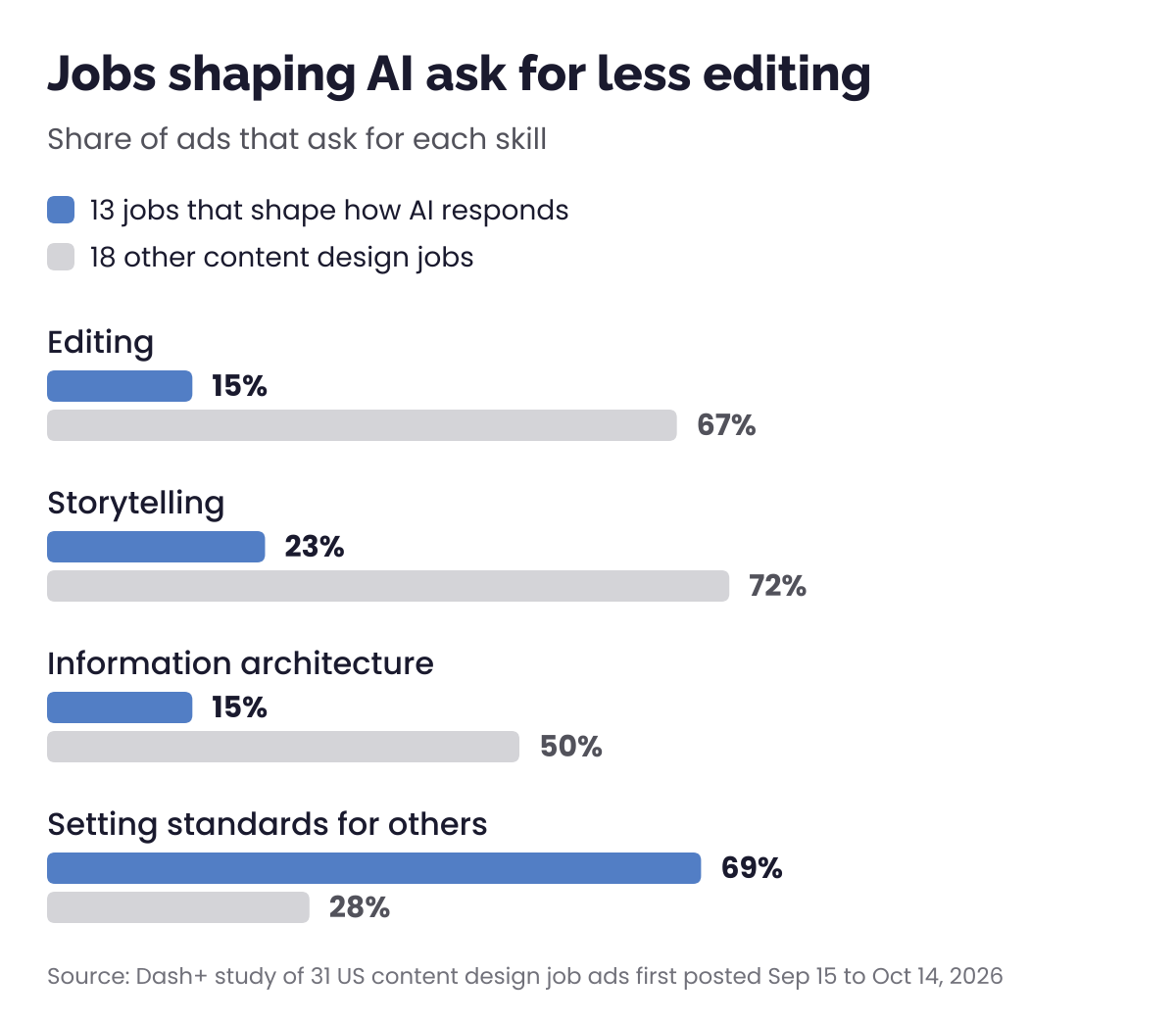
The differences are striking. Editing appears in two of the 13 model-behavior ads, compared with 12 of the other 18. Storytelling appears in three, compared with 13. But standard-setting responsibilities appear in nine of the model-behavior ads, versus five of the others.
The distinction is easy to miss if you search by job title. Google's Senior UX Content Designer position for Shopping, posted October 9, focuses on AI response strategy, system instructions, and evaluation rubrics. It asks for experience shaping model responses. Four days later, Google posted a Senior UX Writer and Content Designer role for Android and Pixel focused on conventional product-content frameworks, interface content, and voice across the Android experience.
Same employer, similar titles, but a pretty different focus.
4. How technical are the requirements?
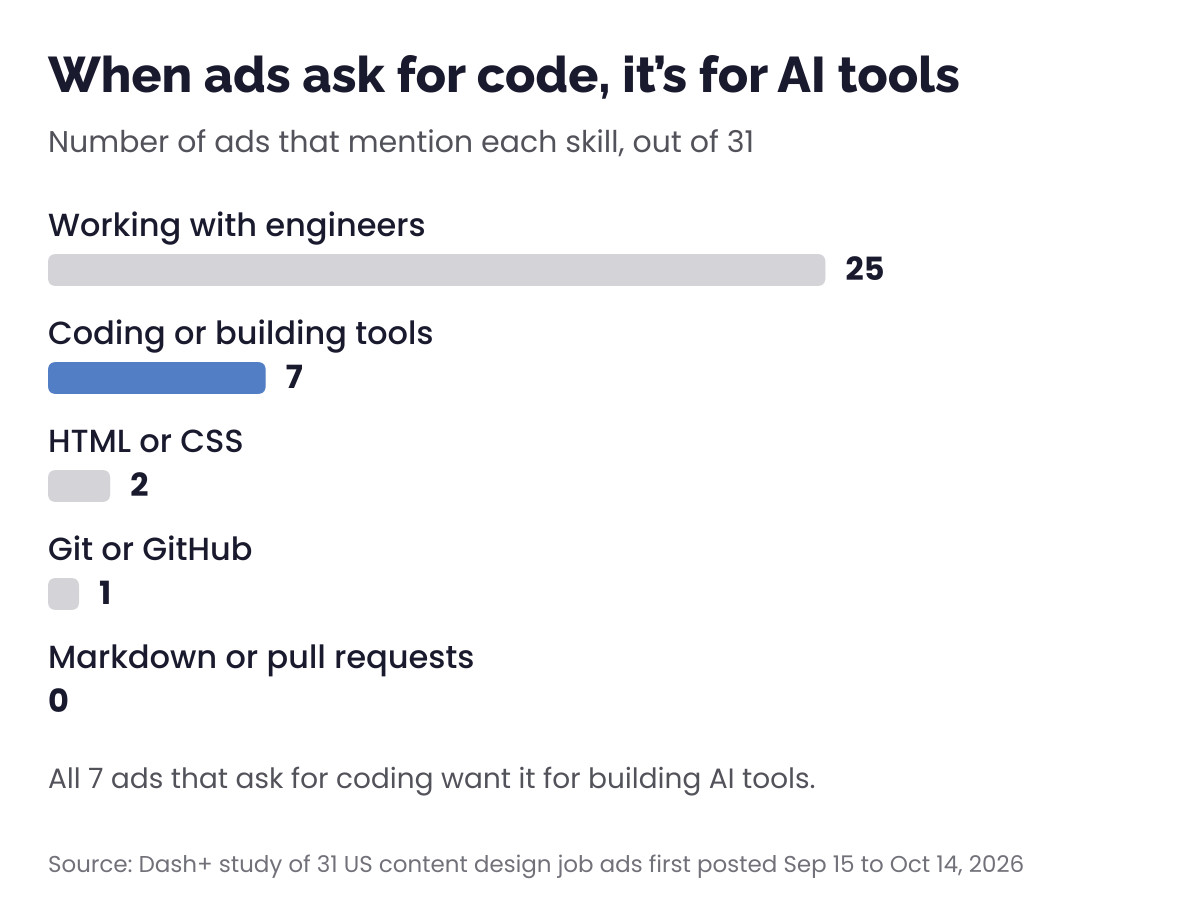
Only one ad mentions Git or GitHub, one mentions repository editing, and none names Markdown or pull requests.
At the other end, seven ads ask for programming, automation, or tool building, and all seven connect that work to AI. Intuit's Staff Conversation Designer – AI Design Technologist is a particularly concrete example: working knowledge of Python, HTML, XML, and regex, plus building Claude Code skills to generate evaluation datasets and running automated AI assessments.
The only GitHub mention is in Salesforce's Summer 2027 Content Design Internship, where interns are expected to work with Claude, OpenCode, GitHub, and Figma to develop prototypes. Like we said about the IBM internship...this is where the industry is going.
5. What does the pay look like?
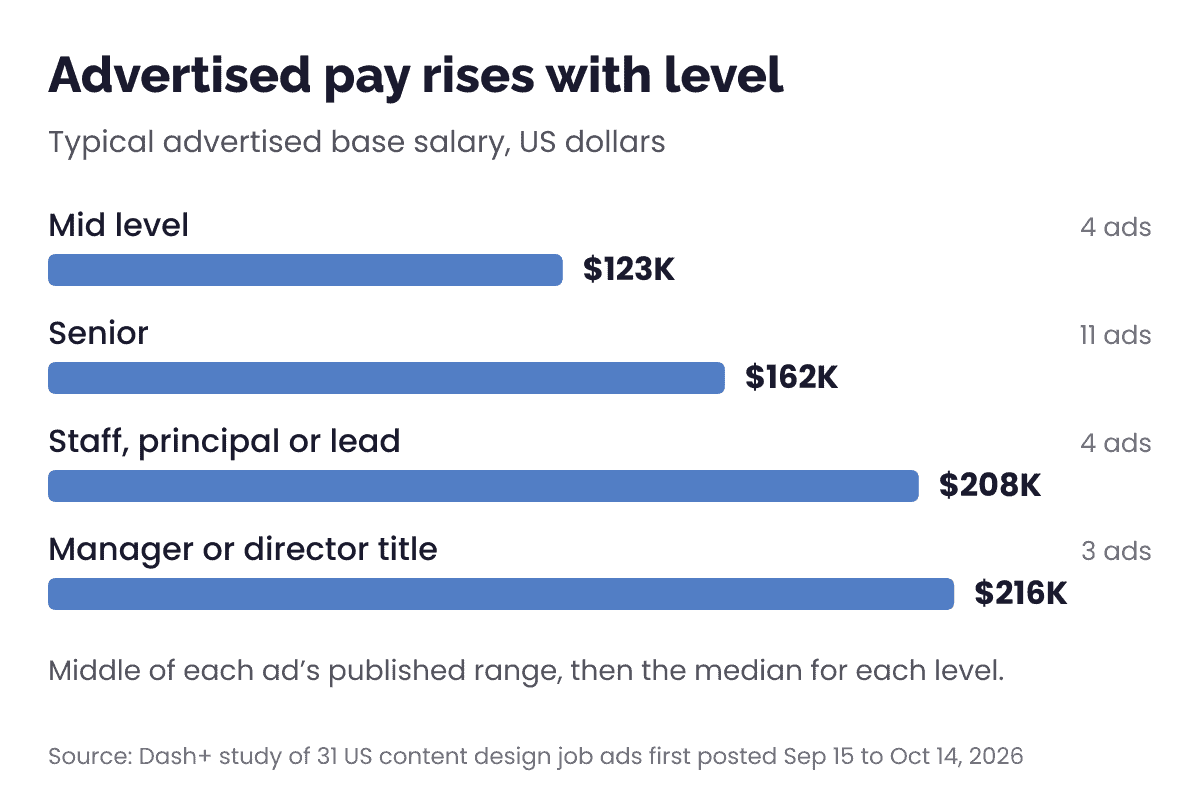
Twenty-six of the 31 ads disclosed some form of pay. Twenty-three gave comparable annual US base-pay ranges. The median advertised range for senior roles was US$133,000–$190,000 (11 ads). For staff, principal, and lead roles it was US$176,500–$239,000 (four ads).
You can see some striking individual ranges too. Google's Shopping position, centered on AI responses and evaluation, lists $159,000–$230,000 in base pay. Its Android and Pixel position lists $144,000–$208,000. But we don't know whether Google classifies them at precisely the same internal level, and the whole sample combines different employers and locations.
So, what does this mean?
This is just an initial review of available jobs. We'll do more in the months to come and compare what we find. But here are some key thoughts.
Search for responsibilities, not just titles. Six of the 13 model-behavior/evaluation positions in our sample have conventional content design or UX writing titles. If that's the work you want, search for terms such as model evaluation, response quality, conversation design, and system instructions alongside the usual job titles.
Make your portfolio show the work you're applying to do. For a role involving AI evaluation, an example of how you defined quality criteria, tested responses, spotted failures, and changed the system may be more relevant than polished interface copy alone.
Be specific about technical skills. Seven ads mention coding, automation, or tool building, and all seven relate it to AI. GitHub appears in just one; Markdown and pull requests aren't named at all. Working in a repository, building an evaluation tool, and designing a content system are different activities. Learn the tools that support the work you want to do.
Test what ownership means. Twenty-four ads describe some kind of strategic ownership, standard-setting, or roadmap influence. That's a promise in a job description, not proof of what the successful candidate will control. If an ad says you'll define standards or improve AI response quality, ask who makes those decisions now.
There's a point here for hiring managers, too. If a conventional content design title can describe everything from interface writing to model evaluation, spell out the work rather than relying on the title. Candidates need to know what they're joining.
Ads in this month's study
All 31 US job ads we analyzed for Inside the Job Market, from 22 employers, first posted September 15 to October 14, 2026. Each link goes to the employer's own posting. Some roles may have closed since.
- Abbott (Exact Sciences Corp): Sr. Content Strategist · Oct 8
- Airbnb: Staff UX Writer, AI · Oct 1
- Capital One: Content Designer, Manager - Core Card Experiences · Sep 18
- Capital One: Senior Manager, Content Design (Product Design) · Oct 7
- Consilio: Lead UX Content Designer · Sep 28
- Crown Equipment Corporation: Senior UX Content Writer (Hybrid Remote Ohio) · Oct 9
- Etsy: Staff Content Designer, UX Platform · Oct 2
- Expedia Group: Content Designer III - Traveler Brands (XD) · Oct 14
- Google: Senior Model UX Designer, GeminiApp, DeepMind · Sep 17
- Google: Staff UX Model Designer, YouTube Ads and AViD · Sep 24
- Google: Senior UX Content Designer, Google Shopping · Oct 9
- Google: Senior UX Writer and Content Designer, Android and Pixel · Oct 13
- Google: UX Writer and Content Designer, Google Ads · Oct 13
- Guardian Life: Conversational AI Designer · Sep 29
- HARMAN International: UX Strategic Writer and Content Designer, Consumer Audio App · Sep 21
- Illumio: Content Designer I · Sep 16
- Intuit: Senior Conversation Designer - AI Conversation Design · Oct 14
- Intuit: Staff Conversation Designer - AI Design Technologist · Oct 14
- Jellyvision: Sr. UX Writer · Sep 18
- JPMorgan Chase: Content Design, Vice President-Small Business Design & Customer Experience · Sep 21
- JPMorgan Chase: Content Design Senior Associate - Co-Brand Card · Sep 22
- JPMorgan Chase: Conversation Design, Vice President · Oct 7
- JPMorgan Chase: Content Design Vice President - Customer Offer Experience · Oct 9
- MNTN: Content Designer · Oct 2
- Norwegian Cruise Line Holdings: Principal Content Strategist · Sep 28
- Robinhood: Senior Content Designer · Sep 21
- Salesforce: Summer 2027 Internship - Content Design · Oct 7
- ServiceNow: Senior Director, Content Design · Sep 21
- TIAA: Conversational Design CW · Oct 9
- TikTok: Content Designer - TikTok Design · Oct 12
- Wealthsimple: Staff Content Designer, Investing · Sep 15