


Get hired: job hunting and portfolio advice for content designers

Patrick Stafford
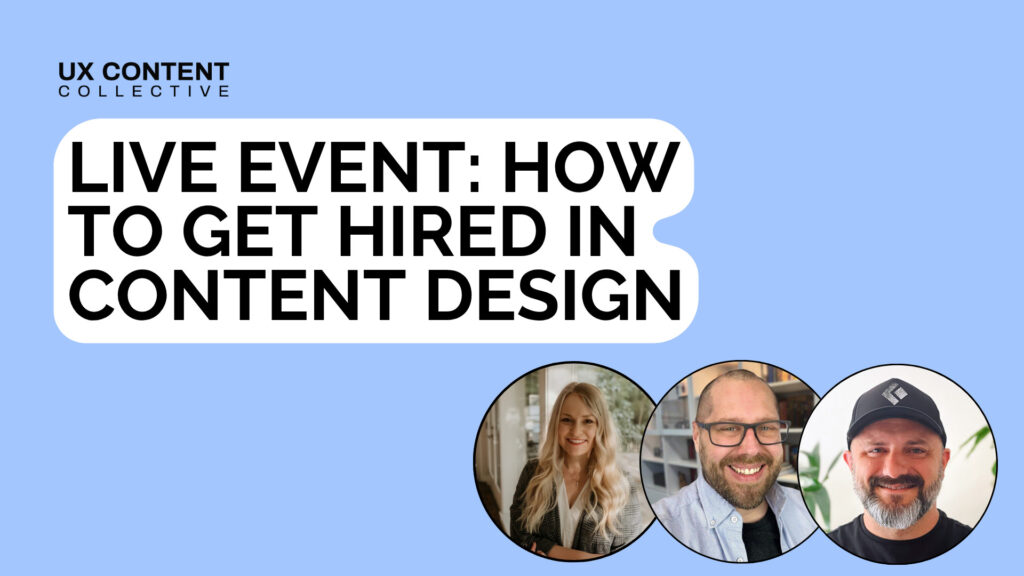
We recently hosted a live session on job hunting and portfolio strategies for content designers. Now, the full event recording is online for you to watch.
Watch our panel tackle tough questions about the content design job market:
- Patrick Stafford – Cofounder and CEO, UX Content Collective
- Casey Webb – Senior Content Designer, Snap Finance
- Andrew Stein – Director and Lead Content Strategist for Conversation Design, TIAA
The market is moving in both directions
Layoffs have hit a lot of tech roles, and companies are often pointing to AI restructuring as the reason (whether or not that’s always true…). At the same time, many other employers are hiring content designers and UX writers. Competition is high, and AI screening tools make getting noticed harder.
Here are a few strategies we discussed in our panel to give you some ideas.
Content design your application
- Treat your resume and portfolio like a product. Lead with the most important thing about you, and resist the urge to cram everything in. A wall of text gets skipped.
- Content designers write microcopy and obsess over hierarchy for a living, then ignore all of that on their own resumes. Make your resume “boring” by stripping things down to scannable bullet points in a plain document.
- Use a basic template, like the Harvard resume template, and let your work and your results be the thing that stands out instead of the design.
- Tailor every application, and back it with results
Sending 150 generic applications isn’t the same as applying. Applying means reordering your bullets for each role, using the keywords from the job ad, and mirroring the structure of what they say they want.
(Check out the recording – Andrew Stein mentions he often cross-checks LinkedIn to see whether someone genuinely tailored their application, so be authentic and don’t inflate your titles.)
The other recurring gap is bullet points with no results. Every line under a role should carry a result or a metric that signals scale. If you don’t have hard numbers, qualitative signal still counts, like internal testing, a quick survey, or feedback that the work was good enough to ship.
Referrals beat the algorithm
With AI screening everywhere, referrals are one of the best ways to get attention…but there are two common mistakes: asking strangers for a referral, and beating around the bush instead of asking directly.
If you’re trying to make a connection, reach out on LinkedIn for a genuine, specific conversation, not a spammy template. A short call often turns into a referral once there’s a real relationship.
Frame case studies around the problem, not the task
A common weakness is case studies that describe what you did, like “rewrote the onboarding copy,” instead of the problem you were solving, like a churn issue or a strategic shift in the business.
The task is the solution. Framing the real problem is how you show strategic thinking, which is exactly what hiring managers say content designers often lack.
A few more case study notes:
- Tell it as a story. Use “but” and “therefore” between events rather than “and then,” so it reads as a narrative instead of a checklist
- One strong case study often beats many. If you send several, say which one to start with
- Make your individual role clear. “We” is fine, but the hiring manager needs to know what you drove
- Explain why you made decisions, not just what you did
But what about results when you don’t have numbers? Capture qualitative signal as you go: Screenshots of leadership saying yes, feedback from a UXR (user experience research) partner, or work that got scaled across the org all show that you drove change.
Cover letters, portfolios, and personality
Many hiring managers don’t read cover letters, but you don’t lose any ground by writing one. If you write one, don’t repeat your resume. Use it for personality and to explain why you want the work.
Personality belongs on your portfolio site, not your resume. That’s where color, tone, and your own flair can come in. Andrew raised a nice view on how much personality is too much: there basically isn’t a limit, because you’re going to work with this person. A portfolio is also a good place for thought leadership, talks, or side projects.
One important caveat: a portfolio site isn’t required.
Coachability, curiosity, and AI
It can be hard to stand out, but there are some methods:
- Demonstrating “coachability” – the ability to say you’re wrong, or don’t know something but are willing to learn
- Sharing times when you’ve changed your mind on projects
- Showing curiosity, not expertise
Not every job search is the same
Job searching can be exhausting, but you’re far better off in tailoring your applications to each job rather than creating one version of a portfolio and blasting it out.
If you’re interested in learning more, we’d definitely recommend either watching the recording or reading the transcript below. There’s plenty of good advice, whether or not you’re searching for your next content design role.
Read the full transcript
Get Hired: Job Hunting and Portfolio Strategies for Content Designers
Speaker 1: [00:00:02] Hi everyone. Welcome. Welcome today. Thank you for joining us. Uh, we have, uh, sorry for starting a minute or so late. We were just getting a couple of things sorted out. Uh, yes. Hello. Feel free to say hello in the chat. Um, thank you so much for coming today. Uh, we’re really excited to talk about this topic. There’s a lot to talk about. We had nearly 500 people registered. Uh, so we are expecting a bit of a crowd. Um, but, uh, we don’t have too much time, so we’re gonna, we’re gonna get straight into it today. Um, so, uh, today we’re talking about job hunting and portfolio strategies for content designers. Now, just a little bit of housekeeping first. Um, first of all, I should say this session is being recorded. Uh, and you will be able to get access to the recording afterwards. So if you need to drop off, uh, don’t worry, you will get access to a recording. Please say hello in the chat. Say where you’re where you’re logging in from, uh, where you’re joining us from. I always love seeing the, uh, usually quite diverse international audiences for these events. So please, uh, please, uh, drop in the chat. Oh, Berlin. Uh, guten tag. Um, and also, we will have time for questions.
Speaker 1: [00:01:23] Um, so if you would like to ask a question, please drop it in the Q&A section. Um, and, uh, you can upvote other people’s questions as well. So we will have time for questions. I will say, if you do have questions, put them in the Q&A, not the chat because the chat will, uh, the chat will probably be moving quickly and we may not see it, so feel free to put it in the Q&A and also be sure to stay until the end if you can. Um, because we, uh, we do have a, a special career resource for attendees only, so don’t drop off before then. Um, okay, so who’s joining us today? So I’m Patrick Stafford. I run UX Content Collective joining me today, uh, some fantastic people. We have Casey Webb, who’s the senior content designer at Snap Finance, and Andrew Stein, who is a director, lead content strategist of conversation design at TIAA. So Casey and Andrew, thank you so much for joining us today. Uh, I am personally a huge fan of both of you. And I know that you’re going to have, uh, a lot to say today about getting hired and portfolios and all that fun stuff. All right. So let’s, uh, let’s get going. I want to make sure that we have enough time for questions.
Speaker 1: [00:02:52] So I’m going to get into our first topic here. Um, and, uh, I’ve divided this up into sections, but before we get to that, let’s just sort of acknowledge where we are at the minute. Um, the content design job market is in an interesting state right now. So as everyone knows, there have been several companies that have announced layoffs across a number of tech roles, not just content design. In fact, it’s a lot of different roles. And that now these companies are saying that’s due to AI restructuring. How true that is is probably up for debate. Um, what’s also true is that there are also companies hiring a lot of content designers and UX writers. So I know Google, for instance, is hiring a lot of people. Paypal has been hiring a lot of people. Uh, if you go online on LinkedIn and you search, you know, content design layoffs, you will see a number of different posts. You also see a number of posts of people being hired. So it’s clear that the market is is moving in both directions. But it is absolutely true that competition is high. And so as a result, getting noticed can be difficult. Not just because of the number of people who are hiring, but also because of the way that companies are hiring.
Speaker 1: [00:04:09] Now, with regard to AI screening and a bunch of different tools that they’re using. So our goal today is to not only help you with some strategies on how to stand out and how to possibly get past some of those screening techniques, but also to once you do get noticed, how do you actually perform well and how do you how do you stand out from others? So the first section, I want to talk about applications here because that’s really where everything starts. What you put in your application forward. And we’ve got a number of points that we’ll get to in a second, but I really want to throw it to our panelists today. And you two come at this from two different perspectives, uh, both, uh, getting a job and hiring people. And Andrew, I want to start with you. Um, because you, you are in charge of hiring people, uh, content designers, conversation designers. I’m really curious to hear from you. And you probably could answer, you know, you could talk for 40 minutes about this alone, but when you see applications coming through, what are people getting wrong? Like what, what are the big mistakes that you’re seeing from people when they’re applying?
Speaker 2: [00:05:27] Yeah. Um, well, they, they come in all shapes and sizes. Um, and I mean, the first thing I think that’s important to realize if you haven’t done hiring yourself, if you’re just on the side of trying to get hired is just it’s empathy, right? Like put yourself in the shoes of, of the hiring manager. And that’s hard because as someone looking for a job, Being out of a job. Your world is so big in that moment, it’s really hard to step outside of that. And and I understand that. So I think everything we’re saying here I’d like to pepper with a lot of grace like this is a tough thing to go through. Um, and so hopefully everything we’re seeing here can be encouragement and, and hopefully make lives easier, not more complicated. Um, but it’s a really difficult place to be in and I just want to acknowledge that up front. It’s really hard to tell somebody, hey, you’re going through a hard thing. Maybe you just got laid off or you’ve been out of work for a while now. Have empathy for the hiring manager that doesn’t land well, potentially. Um, but I think it can be a really big unlock. Why? Because hiring managers, depending on their situation and their organization and how they’re set up, might be reviewing anywhere from, you know, dozens to hundreds of applications. Um, again, if you’re in a larger organization, there’s screening that might happen before, if it’s a smaller organization, maybe that hiring manager is also has to do that screening themselves. Uh, and so I, I think that’s the first thing that I would start with is content design your application thinking, okay, this thing needs to be really digestible.
Speaker 2: [00:07:03] Like do, do the three second test, right? When you look at this, can I look at this and get something that grabs my attention and makes me want to dive in? We all know as content designers, the first thing, uh, that, you know, the, the first moments that somebody engages with our content, if we don’t grab them, there’s something else right behind it that’s probably begging for their attention too. Um, and so in our applications, I think one of the things that some people get wrong is trying to just cram everything in there. I’ve been guilty of this. I’m like, I did all this stuff. I was in charge of all these things. This is juicy. They need to know about this. Chances are they’re not going to know about it if I just give them a waterfall of words. Um, and so I think that’s the first piece is to content design your application. So really starting very high level. What’s the thing about me that’s most important to know? Uh, and just start there. So I don’t want to, um, take over the conversation, but, but I would start there with understanding that the person that’s looking at your application might only have a few minutes to scan it. Um, at best. And so thinking through that lens, a wall of text is going to be really discouraging to them to be able to find what’s important and valuable to them that makes them want to dig in more and give it that extra time that, that they need to, for them to learn more about you.
Speaker 1: [00:08:32] Yeah, it’s interesting how often, and we see this as well with the portfolios and, and resumes that we review at UX. It’s amazing how often people will be able to talk very well about that. The content hierarchy they use in their own work and so on, but they don’t apply that same standard to their to their resume and their applications and case studies. Casey, you’re nodding your head. You know, you’ve been through this process. Um, can you talk about a little bit about how you, how you’ve done that with your own applications and what that looks like for you?
Speaker 3: [00:09:10] Yeah, absolutely. And I think it’s, um, there’s some irony there that we write microcopy for a living, but yet when it comes to my own portfolio and resume, I tend to do the opposite of microcopy. And my first pass is usually extra words and explaining all of it a lot. Um, so yes, to, uh, piggyback off of what Andrew was talking about, uh, I definitely go through many different iterations before I apply for jobs and, um, send resumes out. But I will say something that I’ve been doing more lately over the past few years of going through the interview process. And I know we’ll touch more on portfolios later, but I’ve been diving more into Figma slides and trying to take some of the highlights and make something I can export into PDFs as well. I’ve gotten, um, more boring, I guess you could say with my resume over the years. I think eight plus years ago I was trying to add more, uh, fun color and other things to maybe stand out. And that strategy has drastically shifted. And now I’m more in a Google doc and trying to strip things down to really succinct, scannable bullets, um, things that people can digest quickly. And then I’ve been putting a little bit more focus on the supplemental materials and PDFs and things that I can kind of add to support that and send with it. Um, and another thing we can chat about more later, but depending on the company, I’ll also, uh, tap into some branded colors and different things too, and try to make it tie into the company I’m applying for as well. But, um, can definitely be hard. And I find it can be especially challenging to approach your work critically. And when you look at it yourself so many times and you know your process. So I would definitely say having peers review and other people that you can reach out to in your network has been a huge, uh, thing that has helped me throughout the process too.
Speaker 1: [00:10:58] Yeah, I definitely second that. You know, when I was attempting to get hired. Sending it out for feedback was absolutely useful, very vulnerable because you’re opening yourself up to criticism. But it’s just like anything, you know, why do it without without practicing? I want to touch on something you said about how your resume has become more boring over time. And I 100% agree with this. I’ve seen too many resumes that number one, like are too long. Um, and I would say that a resume as opposed to, you know, your portfolio site, you can still have your personality in your resume, but it is really the the first step for someone to get a sense of, can you actually do this job? And I’m speaking as someone who’s hired content designers before hiring managers go into this, not with them. Well, look, I’ll speak for myself and the people I know. I’m sure there might be others out there, but you go into this as a hiring manager wanting the next application to be the person you hire because you you have a need, you really want to fill it. And everything that gets in the way of that is an excuse or a reason not to hire them. Um, but you’re really wanting to. And so I say in this list, you know, a, your resume should be boring in that I would use a, a very basic template. I think there’s a, I think it’s called like the Harvard resume template.
Speaker 1: [00:12:33] That’s like the, the, the generic sort of very, very basic one. And sometimes people look at that and think, oh, well, that’s not going to stand out, but you actually don’t need that to be the thing that stands out. What you need is your your work and your results to stand out. Um, and that’s why I say the, the point in here about key words. So one thing that I’ve noticed is that people will, will say, oh, I’ve sent out, you know, uh, 150 applications. And I have to wonder if you’re not changing your resume to suit the job at each time. Meaning are you shifting the order of the bullet points under each job? Are you using the keywords that they reference in the job ad? Are you emphasizing certain work more than others? Have you really applied or have you just sent an application to me that’s like two different things. Like if you’ve sent an application to me that’s like a generic like, okay, I’m sending you my material, but if you’ve applied for a job, you have literally applied yourself to, uh, changing your resume and making it more attractive. Andrew. I’m wondering, can you tell the difference when you get an application as to what a generic application is versus someone who’s actually really attempted to tailor their work to the job?
Speaker 2: [00:13:52] Yeah. And it’s, it’s kind of a. It can go well and it can go poorly, but I always check. So the, the way that I get that signal is, I mean, I’m pretty active on LinkedIn. Uh, it’s where I built community. It’s where I like to learn about people. It’s where you can see how people do show up if they are active on LinkedIn. Um, so whenever I see a resume that catches my eye, I absolutely always go and check on that person’s LinkedIn and that, that can do one of two things. It can confirm, oh, yes, they really did put some time into this application, which gives me a signal. They actually think this could be a valuable role, rather than they’re just sending this out to hundreds of places, anywhere that that’ll take it. I understand somebody doing that. I mean, we all need work, so I’m not judging that whatsoever. But as a hiring manager, I’m looking for the people that I think. I think they actually want to be here. Like they’re motivated to be here. Um, so yes, if I go back and I look at that at their LinkedIn, I might see slightly different, uh, information under each jobs. But if it’s, if it’s relatable and I see, okay, yeah, LinkedIn, they don’t know who their audience might be. So it’s a little more generic.
Speaker 2: [00:15:08] They’ve, they’ve actually taken their resume and applied it to being able to work here. I see that as a win, right? Like this. This person is motivated to put in the extra effort to, to, to grab my attention. It can also show me, oh my gosh, what’s on their LinkedIn hardly even matches what they’re sending me. Or did, did they just modify their resume? Uh, what they sent me because they really want a job, but it’s not maybe necessarily what they were doing. So it can go both ways, I think. You, I think you have to be genuine, right? Like you can’t make stuff up. Um, if, if you were a content designer somewhere, but you were doing conversation design work, I don’t care if you put your title as conversation designer there. That doesn’t turn me off whatsoever. Um, but if you were maybe a technical writer, you know, writing instructions for a print manual and you put conversation designer, AI conversation designer, right, then that’s a red flag to me. Um, but being able to go back and see, okay. Yeah, I can tell that they put the work in to match their skills and what they were doing to what we’re looking for. That goes a long way. It definitely makes resumes rise to the top for me for sure.
Speaker 1: [00:16:15] I also think that there’s something about reflecting the nature of the job ad in the way you structure your experience. So every job ad will have a bullet list of this is what we want. Uh, if you match that pattern to your application. I tend to think that that’s going to have good results as well. Um, just a quick note on referrals because I think this is a key thing. So there’s been a huge amount of AI use in hiring and any type of big company or even smaller companies will use AI screening to, to look at any type of application. And so the big advice is really app referrals are one of the, the best ways to, to get attention. Um, Casey, I know that you have utilized that in the past. I tend to think that people approach referrals. Uh, I think in, in, in two wrong ways. One is like, don’t ask someone for a referral if you don’t know them. Like, you know, like, if you don’t know them, like, don’t ask them like they don’t know you. And so they’re going to put, you’re going to put yourself in the position of having someone tell you no. But also like, you don’t have to, to, to delay or beat around the bush. You can just ask, hey, would you would it be okay if you referred me for this role? Casey, I’m wondering your, your experience with that.
Speaker 3: [00:17:45] Yeah, referrals have been a key way that I’ve gotten connected and gotten that interview and that conversation started. So, um, a huge proponent of referrals. And I will say, even in times when I don’t necessarily know someone at the company, sometimes I will reach out to people at the company on LinkedIn and just genuinely have a conversation with them and say, hey, what are your thoughts on working at this company? What are some things that you enjoy? Do you know anything about this team? And sometimes people don’t respond on LinkedIn and that’s totally okay. But other times I’ve had Google Meet calls with people that I don’t know that are just willing to take a 20 minute chat with me and have a conversation. And I’ve had people before say, hey, I actually think you could be a really good fit. I’m happy to send a referral in now that we’ve had a face to face dialogue and we’ve gotten to know each other a little bit. So I think tailoring your LinkedIn messages, um, in an authentic way that doesn’t feel spammy, that’s really like, hey, I have specific questions. Don’t just send out a blanket template that feels like anyone could send it. Um, look up specific things, say, hey, I noticed you’ve worked here for six years. That’s awesome. What are some things we’d love to pick your brain about it. Um, so don’t be afraid of the cold referral, I would say, because it’s worked out well for me in the past, but I think it’s all about that authenticity piece and building that relationship.
Speaker 1: [00:19:08] It’s a good point about asking for a, a, a, a meet because you might, I might not know if I’m applying to a job at Andrews Company. I might not know anyone there. But Casey, you might know someone there. So I might ask you, hey, you know, I noticed your friend, you know, works at this company. Could you please introduce us? I’m trying to get, you know, like, sometimes you might feel a little hesitant at doing that because, like, oh, I don’t know, it feels a little desperate or whatever, but I like, what else are you going to do? Like the, the, the alternative is just not doing anything right. Like, so you might as well try something. I want to move on to our next section on case studies. But one, one key thing I want to put here is, um, I read too many resumes that don’t have results. And every bullet point you put under your, your experience needs to either have, I think, a result or some metric that, uh, gives a sense of scale. So I see too many bullet points that were, that are just like, I was responsible for this. And it’s like, well, okay, that’s fine. But it doesn’t, uh, it doesn’t really tell me how good you were at doing that, right? Like what was the what was the effect? Andrew. I see you nodding your head. So I’m sure you see this as well.
Speaker 2: [00:20:29] I do, I do, and when I speak with people, um, I recently had a, a, a friend who’s just got unbelievable experience in our industry, uh, share their resume. And, and one of the things I noticed is that the results were missing. It’s really hard as content people to get the results that we think we need to put in here. And so I think we are like, well, I don’t know how it worked. I don’t know what it did. Uh, I didn’t have access to that information. And we stopped there. And I think this kind of goes back to the original post that I think inspired us to all talk about this, which is there’s, there are so many results that you can add in and they look very different. Um, starting from we dog footed this or we tested it out within our, our own group. Like that’s some kind of signal. You know what, what was the feedback we got there or the scale, like you mentioned, how many people was, was this solution serving even there is it’s something, right, to show the what I was working on and how many people it was impacting. It’s not necessarily a result, but it is it is giving some color to what you were working on. Um, there’s also, you know, if, if you do internal testing or user research, right? There can be metrics there.
Speaker 2: [00:21:47] Um, you know, we showed these two things in a survey and 75% of people said they’d be more likely to click through if they got this one versus the old one, right? Like there’s a lot of results that you can lean into. And at the end of the day, you can do AI testing, right? You can feed it to an LM and say, you know, how much improvement did I get from this based on X, Y, Z metrics? It’s not a real person. It’s not the end all be all. Um, but it’s still more signal. And I think just showing that you’re attentive to results at whatever fidelity you can get, at whatever maturity you can get. That in and of itself, I think speaks to hiring managers that this person isn’t just here to do a job right to, to complete or to fulfill the thing they’re hired to do, which is write this copy or work with this team or whatever they’re thinking about is this thing what’s the ultimate purpose for this? They’re focused on it. It just it tells me that they are more focused on the results than just doing the thing.
Speaker 1: [00:22:49] Yep, absolutely. Great. Well, let’s move on to our next section because we’re getting a lot of really great questions. So I want to make sure that we have time for those. So I want to talk about case studies a little bit. Now one of the big problems that we see with case studies is that people really define what they did, um, rather than the problem that they were trying to solve. And I know that this is such a UX cliche, like what’s the problem with solving? But I often think that the case studies aren’t framed that way. I will read a lot of case studies that are rewrite onboarding copy for, you know, for this feature. And that’s not the problem. The problem is there’s a churn issue or there’s something happening in the organization. So that an emphasis needs to be on certain products more than others. That’s the problem. You rewriting the onboarding copy is the solution. And I think like one of the key critiques we get from hiring managers we talk to is that there’s a lack of strategic thinking on behalf of content designers and reframing your case studies to talk about the bigger issue and how what you’re doing relates to that bigger issue can show that strategic thinking. Casey, I know you’ve written a number of different case studies before and you’ve worked across a range of different industries. I’m wondering what your approach has been to writing your case studies and how you’ve navigated this problem.
Speaker 3: [00:24:27] Yeah, I think one of the things that I’ve, um, done more in recent years and this kind of ties into case studies and resumes a little bit, but also showing your personality. I’ve done a lot more storytelling and context setting and kind of setting a scene at the beginning and, um, really kind of crafted the narrative around the problem and tried to make that compelling. So when you’re going through the case study, you’re kind of hooked on the story or the scene that we’re setting. And then as we dive into the problem, and then I think another piece too, is just continuously pointing back to that problem because some projects are quite large and the presentation of them can be very long. And so reminding everyone, this is the problem we were solving, especially as you go through case studies and you’re talking about these are some bumps on the road we hit along the way. And this is how we had to pivot and going back here. Um, but if you I find that in the case studies where I’ve kind of told a story and had a consistent narrative, that thread line all the way through the case study has really stood out. Um, and it can make your case study presentation more memorable as well. And as content designers, we’re storytellers. So we can kind of play into that and be a little creative as long as we, uh, keep everything tied to how we can point to our strategic thinking and communicating that solution that we help drive.
Speaker 1: [00:25:45] Yeah, absolutely. Andrew. When you’re reading a case study, what do you often see as the big mistakes or maybe just the things that, uh, the yeah, I guess mistakes is a good word. Like what do you, what do you consistently see across maybe like your, your mid or poor performing case studies?
Speaker 2: [00:26:04] Yeah, yeah. There’s a few things. One is uh, too many. Um, I, I think one solid case study that really shows me how that person works, how that person thinks, how they, how they’re able to overcome obstacles and problem solve and achieve a solution, even if the way they started isn’t where they ended up. Um, I, I really don’t want to see more than one case study. I mean, yes, if I’m, if I’m reading and I, you know, don’t quite have the full picture, it’s great to have that second and third one. Um, I don’t, I’m not suggesting everyone go out and just do one case study. Uh, but the point is, is that too many case studies, um, if you’re sending them to me and I don’t know which one to pick or where to start, it’s I love when somebody sends me three case studies and then I can narrow it down. Which one do I want to start with? Or maybe they tell me which one they want to start with. That’s one thing. The other thing is when it’s really not clear what the the applicant’s role was in the case study. If there’s a lot of. We did this and we explored this and everything’s we, you know, at that point, I mean, obviously we work in teams. So we, we have to there is a we here. But if I can’t really understand what your contribution was, then it’s really hard to know. Is this a is this just a good story? But you didn’t do much on it or were you driving these things? Were you the change agent here that helped unlock X, Y, Z? Um, so really taking ownership of what you brought to it, I think is really important. And it’s hard. We all I think there’s just a tendency to, for a lot of people, including me, to not want to just show off and talk about how great I am.
Speaker 2: [00:27:51] Look at me. Um, but you’re not, you’re helping the hiring manager know what I can bring the value that I can bring. And the hiring manager really wants to know that. So there’s, there’s no pride to be seen here. Um, the other thing is just really getting caught in the weeds of stuff that was done versus the why certain decisions were made or why I’m including this. If I see that you did all the things you should do on a project, I think, yep, that’s what you’re supposed to do. But if I understand, well, we had these two paths to take and I chose this one or I chose both. And here’s why, because I wanted to explore and diverge before I converge. And then that led to this, like, why did you do what you did? Uh, and what were the outcomes of it? That’s really important. And also honesty. Um, you know, I’ve, I’ve looked at resumes where there are no results going back to results. And I, you know, and I’ll ask what were the outcomes? And, and they’ll tell me, I have no idea. And I’m like, I bet you have some ideas. Even if you don’t know the, the gold standard results, you know, we made this much more money as a result of what I did. And I’m the hero. But what are those things along the way that gave you signal that you were on the right path or that you weren’t and then allowed you to pivot. Those kind of things to me are gold and and a lot of times can be missing from a good case study.
Speaker 1: [00:29:15] You just touched on something that has been asked in one of the questions, and I’m going to put that question up to us now. Uh, rather than rather than later, uh, because it’s got a few upvotes and I want to make sure we get to it. So Melissa asks, what can I do if I don’t have the quantifiable results from my recent work? I often partnered with colleagues in marketing, but we never shared outcomes around their KPIs. This is such a common issue that we hear from a lot of people. Like, yeah, I was doing the work, but I didn’t actually end up seeing the main result. But I think you sort of just hit on it there. Andrew. It’s like, well, I’m sure you got signals along the way, even if that signal was qualitative, right? Like even if it was the department saying, yes, we’re happy with this. It meets our metrics. Or like if there’s a, some research that shows like you’re going in the wrong way, like sorry, in the right way. It doesn’t have to be at the very end, as you said, oh, we earned, you know, 20 million from this change. That just has to be signal in the right direction. Casey, you’ve written a number of case studies and you’ve had to navigate this issue. Can you talk about some of the things that you’ve done to try and get those results? Like obviously the gold standard is when you’re doing the work, you know, recording them and asking them and getting results along the way. But obviously that isn’t always realistic. So how have you tried to navigate that?
Speaker 3: [00:30:41] Yeah, I wanted to touch a little bit on the qualitative piece here because I feel like oftentimes, especially as things move so quickly, it can be hard to get that quantitative data. And I think in the past I’ve struggled with like data paralysis or lack of data paralysis of saying, oh, well, I don’t know if I can include that here or if I should talk on it because I didn’t increase this by, you know, 10% and we didn’t have that number. But one thing that I’ve done that I think has been helpful, and this is more on the qualitative side, but taking screenshots in emails or Slack threads, anything where you’ve had maybe executive leadership say, hey, this is awesome. We’ve decided to go with this direction because of X, Y, Z, or, um, just hearing some quick feedback from a uxr partner when they did a quick study that they sent out, um, or when something gets launched and it goes really well and it gets received, um, uh, well by your design leadership and other people. And so I think I’ve been trying to capture a lot of those qualitative pieces where, uh, there’s not necessarily data directly tied to it, but you can still tie it back into the company or, um, you know, say, hey, I did this thing on an email and, uh, product loved it so much that we’re now going to scale it across all of the emails in the organization, all of those different pieces that you can show that you drove change and said, hey, I did this one thing that made a sizable impact. Um, and just taking note of that and making sure that you call those out because I think sometimes we don’t think we should, uh, emphasize those things all the time if we don’t have the percentages.
Speaker 1: [00:32:16] It’s a great point. I really love that point. And I think one thing that you’re also touching on by including like emails and communications is really putting the reader in your shoes as you were doing the work. So many times I’ll read a case study and it feels quite clinical. Like I did this and I did this and I did this. And I’m like, well, what about the meeting where everything blew up and the product manager scrapped everything and you had to start again? Like, or what about the executive who came in and said, I love this, I hate this now we need to redo it. Like those are all real things that happen. And if you were telling someone the story about this project at at work, that’s what you would include. Like and to your point, Andrew, like that also turns it into a narrative. It’s not just this happened and this happened and this happened. I really encourage everyone to go and watch the video I mentioned in my LinkedIn post about this. It’s the guys who make South Park talking about narrative, and they’re basically like, if you can put the words and then in between events, then it’s not interesting what you want is. But and therefore, so this happened, therefore this happened, but this happened, therefore this happened. And so it just makes for a much more interesting, much more interesting read. Um, side note just before we go on to the next section, uh, Andrew, do you read cover letters that that question has the most upvotes in our, in our questions. Do you read them?
Speaker 2: [00:33:46] Uh, I almost never receive them. In fact, I, I, I think it’s been a very long time since I’ve received a cover letter. Uh, I’m not interested in a cover letter. Um, mainly, I mean, I’m interested in everything, so I want to learn so much about the people applying cover letters. I don’t, I don’t know, I, I mean, yes, like if my.
Speaker 1: [00:34:13] Sorry. Go on, go on.
Speaker 2: [00:34:14] No. If some, if if something catches me about the person’s qualifications, I might go then back to the cover letter. But I’m definitely not starting with a cover letter. It’s it’s too time consuming and not targeted to what I’m trying to do and trying to learn. I mean, I, I have to look at resumes to screen who I want to interview. If there was supplemental something there, I might go check then. Um, but it definitely wouldn’t catch my attention to then go look at a resume.
Speaker 1: [00:34:42] Yeah. Fair enough, I think for cover letters. Uh, I see the mistake often of people repeating the resume in the cover letter. And to me, that’s not what a cover letter is for. Um, I agree with you. Like if I saw a resume and I liked the, I liked the person, then I would go read the cover letter. Um, and I see the cover letter as an opportunity to showcase a little bit of personality, uh, and talk about why you’re interested in this work and what you like doing about it. And you can always say like, my results are in my resume, you can read those to me, the cover letter is, is more about showcasing. Yeah, a little bit more of your, your personal style. Um, and I also think that there’s no, there’s no harm in writing a cover letter. So if you like, you might as well write one, um, and write a good one, but that sort of gets to this point here, talking about portfolios and showcasing personality to me, like a portfolio site. And it probably should be a site is where you can actually let a little bit of that personality show off. And, but, but not so much in the resume application phase. Um, because I just think things with like colors and branding are easier to do on a portfolio site and in a resume, it’s probably going to distract whatever type. Also, it’s going to take up space that you don’t necessarily need. Like, I think everyone’s seen those resumes where people will put in like bar charts of their skills and, you know, uh, sort of like it’ll be like a two column thing on the left hand side. There’ll be all sorts of graphs and stuff like that. And I think people mistake that for personality when really like a portfolio site is the opportunity to do that where you can showcase what’s unique about you. I’m wondering, Andrew, like before, I’ll ask you, Casey as well, but Andrew, like this seems like an odd and maybe a weird question, but like, how much personality is too much personality? You know what I’m saying?
Speaker 2: [00:36:50] Uh, yeah. I don’t know that there is too much personality because you’re going to work with that person. Yeah. That might not be the the perfect answer, but you’re going to work with this person. Uh, and you’re going to spend a lot of time with this person. And like it or not, personality is a huge part of hiring process. Uh, because you’re not depending on the way your team operates and depending on how you work as a team, right? If this is like heads down work and you just deliver something versus you’re in the trenches together every day, uh, personality can be a, a smaller or a larger part of the consideration. And, um, I, so I think it’s always nice for me when I can really feel like I know something about a person from their portfolio site. I, I actually love that because then it’s, it tells me something more about what, what we can expect if we’re going to work together. If I think, man, I’m not the fit for them, they seem awesome, but I don’t know that they’re going to like me and vice versa. Because when I’m doing interviews, I always start by saying, you know, this is we get to grill each other, grill me as much as you feel grilled because we want this to be a good fit. Um, and a lot of that happens before the interview, right? Where you’re learning about the person and saying, is, is this person going to be able to, to do the kind of work that we do here? Um, and so I, I love learning about personality.
Speaker 2: [00:38:12] I also think portfolios are a great place to show other things. Like, um, we, we hired, uh, Bridget Larose into, into our team. Phenomenal content designer. One of the things in her portfolio site is she has articles she’s written. So thought leader section, which is awesome because now I see she has a perspective on things and she, she’s owns them enough to publish them and put them out there. Uh, so I think there’s more that you can do with your portfolio site that that really does show like, this is who I am. Um, and so it could be, you know, thought leadership or if you’ve done a talk or showed up, or I built this thing on the side because I’m really passionate about this. Obviously it has to relate somehow. You don’t want to be like, you know, I like to build trains. Um, I don’t know, maybe maybe that’s relevant, but, um, I think it should ultimately what goes in your portfolio site is to say, this is a little bit more about me that you might not get from a resume. Uh, and I think there’s a lot of value in that.
Speaker 1: [00:39:11] Absolutely. Casey. I seem to recall maybe, uh, seeing a Taylor Swift reference in your, in your case studies or one of your applications. Am I imagining that.
Speaker 3: [00:39:25] That was a case study that you saw? Yep. That was one of my narratives. I told I equated a design process to battling for eras tour tickets. And, um, yes, that that did happen, but it was memorable. So, uh, yeah, no, I think in the portfolio too, I think it’s, it’s good to have some personality. And I remember I had a former coworker look at my portfolio one time and he said, oh yes, this is what I would imagine Casey to be on a portfolio. Now that I know you, I’m like, okay, so like the colors and the text. And it wasn’t that I was, uh, I was still talking about content design on the homepage and everything else, but it was just kind of how everything was styled and designed and the tone of voice. And so I think it’s good to let some of that personality out and just kind of show who you are. And then, you know, I tend to put some fun things buried deep on and about me. So if somebody gets that far into my portfolio and they want to know some hobbies that I’m interested in, great. That’s not overly emphasized. But if they’re really curious, it is there.
Speaker 1: [00:40:22] Absolutely. Um, I.
Speaker 2: [00:40:24] Have one point to this though.
Speaker 1: [00:40:25] Um, yeah, absolutely.
Speaker 2: [00:40:26] I just like to say, you know, even though we’re talking about it, and obviously if you have the means and the ability to build a portfolio site, all the better. I don’t require a portfolio site. I don’t expect it. Um, I’ve hired plenty of people that didn’t have it. I got hired at meta without a portfolio site. And actually, I just showed them one portfolio piece. So every hiring manager is different. And and there are jobs for, for you, even if you feel like you don’t have the means or the ability to create a portfolio site, obviously, we’re trying to talk about how you can optimize whatever it is that you’re doing, but don’t. I just wouldn’t want everyone to think, oh my gosh, I don’t have this incredible portfolio site. I’m, I’m excluded from the job market. Absolutely not. I, I’ve hired plenty of people that do not have portfolio sites and they’re incredible people. Um, so just, just wanted to throw that out there. Take, take some of that pressure off if you feel like that excludes you.
Speaker 1: [00:41:25] Yeah. The work matters most, right? Like the work matters most and the results matter most. Absolutely. Um, I’m going to speed through this. Casey, this is a point that you’ve talked about a lot. Uh, the, the ability to appear coachable. And you’ve actually cited this as one of the winning ways that has helped you with, uh, getting hired a couple of times. Could you talk about that a little bit and what you mean by that?
Speaker 3: [00:41:52] Yeah. I know you and I have had this conversation in other forums over the years, but, um, I think one of the key things when I was going through the hiring process is just signaling that you’re coachable and that, um, you’re keen to collaborate. And that is something that I’ve gotten feedback on as I’ve gone throughout the hiring process. And we’re in such a collaborative environment. And I know that the interview process, um, can feel overwhelming and there’s lots of things and you’re practicing and you’re going through all these different pieces. And if someone asks you a question that maybe you don’t know the answer to or you don’t have experience with yet, I think, um, it’s easy to kind of freeze up and go, I don’t know. So let me say something real quick. And throughout the process over the years, I found that in all the moments where I’ve said, I actually haven’t encountered this situation or I’m not sure about that. Or, um, you just kind of walk through the process with humility and honesty and you’re like, yeah, I haven’t experienced that yet, but I’m willing to learn. And that coachability piece comes through. And that’s a piece of feedback that I’ve heard from different hiring managers over the years is, hey, um, I appreciate that you said you hadn’t experienced that yet, but I could tell that you were really coachable and I wanted to work with you. And that’s something that stuck with me over the years. So I think just keeping that mindset as you go through, it’s okay not to have every answer or every experience, but honesty and being willing to learn has got me a long way.
Speaker 1: [00:43:15] Yeah, absolutely. To add to that, I also think the citing times when you’ve had your mind changed, I think is also a good thing to include. I like whenever I’ve interviewed people and they’ve said, you know, I approached it this way, but this person made some convincing arguments. And so we decided to go along that way. You know, all of these things, when you’re interviewing someone, you’re always looking for. I mean, I don’t want to say you’re looking for red flags because that contradicts what I said earlier, and that’s not what I’m saying. But what I mean is that like, it’s an audition, essentially. And so you’re getting your one chance to, uh, say impactful things. So make sure what you say is impactful, you know, make sure that you have anecdotes about when you had your mind changed or when you were able to convince someone or when something. Listen, like all of the interview questions that you’re going to be asked, unless you’re going to interview at McKinsey, where they ask, you know, ridiculous questions, you can, you can be pretty sure you’re going to be asked variations on tell us a time when you had to convince someone of something. Tell us a time when you had to present to executive leadership. Tell us about a time when someone disagreed with you and what you did.
Speaker 1: [00:44:33] Like it’s pretty. You can anticipate when the what these questions are going to be. And so I think a lot of interview prep is really sitting down and not necessarily memorizing a script, but just having, you know, a 5 to 10 anecdotes at hand about how you can, uh, talk about the work you did and how you approached it. Um, and to Casey’s point, appeared coachable. I just want to get to one last category before we take some questions, because we’re running out of time. Um, this is a controversial one because I think like, you can’t possibly know everything that’s going on in the industry. And I wouldn’t expect anyone to, to, to know this. And it can sometimes appear overwhelming. Like you don’t need to listen to everything that Boris at Claude Code is saying about how anthropic works in order to get a job. But I will say like, it probably does help to know a little bit. And even if it’s even if you haven’t necessarily, Uh, got hands on everything. Just staying on top of what’s going in the industry at a broad level. Andrew, I’m wondering, when you’re interviewing content designers, what are you looking for when it comes to current knowledge of the industry and including AI stuff?
Speaker 2: [00:45:51] Yeah. Um, I’m looking for curiosity more than hard skills in AI. Um, you know, sure. It’s great if you’ve done a thing or you, you have expertise in, in a thing, um, that that might be a requirement of a certain job you’re applying for, but in general, uh, I’m looking for curiosity. Um, have, have you, are you sitting on the sidelines and saying, I’ll let everybody else figure this out and then I’ll, I’ll finally put my toe in the water when I’m pushed a little bit. Um, or are you exploring? Are you have, have you tried something out? I, I’ve talked to people outside of interviews that are just there, feel overwhelmed by AI, like, I don’t know where to start. And so I literally was like, well, you know, in those movies when like, there’s the two people that just hate each other and then they get forced, they’re alone on an island together, and they just have to spend time together and they realize, oh, we’ve got a lot of things in common. We know how to work together, whatever. I was like, lock yourself in front of your computer, close every tab except ChatGPT. If, if literally you’re starting there, you’re going to eventually type something and see what it does, right? I mean, we’re starting very basic right here, right? Like how to use ChatGPT. But, but there are still, you know, people that are at that place. Um, but it’s, it’s really that. And yes, if you think you need to be an expert in AI to get hired, well, nobody should get hired because really nobody has expertise at this point. It’s just changing too quickly and it’s still too new to be an expert.
Speaker 2: [00:47:25] Um, I’m not an expert, but what I, what I just gave some advice to somebody was, uh, don’t don’t look for all the solutions to learn. Just just start with one problem that you have or you think other people may have and spend some time with that problem. And then if there is AI to help solve that problem, that’s a good place to start with it. And if you don’t know how to do that, but you do you, you’ve at least got some problems. Well, what better way to show your, your ability to lean into AI than to say, I knew a problem and I didn’t know if I could solve it or not, but I did. I got into Claude and I put in my problem, and I started having a back and forth with Claude about what are some ways that this could be solved with AI? Is AI the right solution or not? And challenge AI? Go back and forth, and you might find that by the end of that 30 minute session, you actually have some pretty interesting results that can kind of get you started down that path. I don’t think you need to go out and become an expert in everything. It’s impossible. Uh, but if you start with one thing, it’s amazing how just momentum encourages momentum, and you’ll be surprised at how much you do learn in in that area just by taking some steps out there. So I just, I look for curiosity. I don’t look for people that feel like they have all the answers. It’s, are you curious? And are you willing to be uncomfortable? And because that’s, that’s the time that we’re in, I think.
Speaker 1: [00:48:49] Yeah, absolutely. And, and to Joseph’s point in the chat, you know, Claude seems to be the only platform anyone seems to care about. Not particularly keen on paying for it. I don’t think you need to pay for it. I really think it is just like Andrew says, sitting down for half an hour thinking, you know what, I’m just going to mess around and see what I can do. Um, and I guarantee you’ll, you’ll that’s enough for a lot of people. We got only ten minutes left. So I want to answer some questions. Um, and Cates is the, the highest rated as someone that despises using LinkedIn, I get it for any reason other than job hunting and staying in touch. How important is it to hiring managers to have a LinkedIn presence? By this I mean regularly posting your own content, commenting on others posts, etc. I. Andrew, I’m going to throw this to you. But like I would say like, not as important as actually having good case studies and results that that is always going to be most important, but it certainly can help. I’m sure to see someone’s name around and pop up.
Speaker 2: [00:49:45] I’m guessing it to me, it’s just like the portfolio site. Um, LinkedIn is very similar. I’ve, I’ve been looking at tons of resumes over the past couple of months. Um, some of the people that looked like the best candidates, uh, were not, they didn’t, they were not even on LinkedIn, which was shocking to me. Uh, but they were dynamite. Um, you know, this might be news to everybody here, but the names that you are recognize on LinkedIn are not necessarily the smartest people in our industry. Um, and I say that as being somebody who’s very active on LinkedIn, there are tons of smart, brilliant people that are not on LinkedIn, but it helps, right? It, it helps. It. Linkedin has helped me get jobs. It’s helped me network and open up. I. I can’t tell you how much LinkedIn has helped my career because I’ve been active on it, not just posting, but actually meeting with people, um, both professionally and I’ve built some really awesome relationships with people. Um, I don’t know that Patrick and I would know each other if I never jumped on LinkedIn. Um, so I’m grateful for that, right? That’s been enriching to me, but it’s also opened up a lot of opportunities. It’s not a requirement if you hate it, if you’re like, I want to invest my time and my energy in other ways, then do that. That’s, that’s totally acceptable. And I think you can still get hired. It’s just one of several ways that you can get recognized. And, and right now, recognition or, or people being aware of your name, it’s really important. I mean, we, it goes without saying, I think that a referral from somebody or somebody saying, hey, check out this resume goes a long way in a hiring manager taking a look at your stuff, because there’s a lot of people out there looking. It can absolutely help. It’s not a requirement, but it can be very helpful. So you got you have to know where your energy is and what you can invest that energy into. That’s going to give you the most reward.
Speaker 1: [00:51:41] Absolutely. And also, if you have a, an idea that you want to put in a blog post or a case study or something like that, if you put it on LinkedIn, I will see it because I searched LinkedIn thoroughly. Uh, and if we, you know, we regularly put blog posts in the dash from people who aren’t on LinkedIn, the dash goes to like 12,000 people every week. So like you just by putting your stuff out there, um, people will see it. So yeah, uh, I agree with all of that. One question here from Joseph. For years I refused to go over two pages for my resume. But in recent months, multiple coaches and recruiters have repeated that my document was too thin and that people in senior positions should have longer resumes. How would you respond to that, Casey? I’m interested to hear your thoughts on this. I’m a one page guy, but, you know, two pages is probably acceptable. I don’t know that I would go any further any more than that. Um, what’s your take on this?
Speaker 3: [00:52:40] My resume has often stayed around the two page mark as of recent. And I think there was also a question that I saw as well about like referrals and testimonials. And part of the reason for that for me too, usually on the bottom, I would put like a couple quotes from coworkers and stuff. That’s just something that I’ve done over the years, just like a quick little blurb. Not always, but I have like usually a longer form resume where I’ll put a couple little extra things. That’s two pages, but I try to keep it to one page, especially if you’re sending it to an ATS system or someone that you don’t know. If I’m sending a resume directly to someone that maybe will pass it along, I’ll kind of send the longer one that maybe has a little bit more detail, but I think as long as you’re communicating, um, and telling that story well, being concise and keeping it to one page is totally fine. Um, but I’ve also, like I said, had the little bit longer version as well.
Speaker 1: [00:53:34] Yeah. Um, I, I’m, I wouldn’t go longer than two pages, but that’s just me. Andrew. What do you think about people who come to you with case studies with assets that they can’t share? So there are lots of people who will get laid off and then don’t have access to assets, or maybe they have confidential work. Well, how do you handle that as a hiring manager and do you get frustrated by it? Obviously, the off the record answer is show it. Everyone does it like at your own risk. But like, if someone can’t. What’s your take on that?
Speaker 2: [00:54:07] Yeah, I mean, I, I just little nod that not suggesting people do this, but I have seen lots of people put their stuff behind a password, um, to protect themselves. Um, but no, I, I don’t know. I, I try to be, you know, just like I’m asking people to be empathetic with the hiring manager. As a hiring manager, I try to lean strongly into empathy for the people that are out there trying to get hired. It’s tough. Um, I was laid off from meta quite unexpectedly and instantly lost access to everything. Uh, so I, I can personally relate to that feeling. Um, and it took like a year and a half for them to actually launch the work I did. So I never got to show it to anybody. As I was interviewing out there. I know how that can go. Um, not every hiring manager might be thinking that way. Uh, so you do want to understand that that maybe yes, that I’m, I have a lot of grace for that situation. Uh, what I found for me personally as a hiring manager is if I can have a really long conversation with the applicant.
Speaker 2: [00:55:17] Uh, it’s like the long form podcast thing. It’s, you know, a politician can have their 15 minute speech down pretty well, but you have a really long conversation with them and you start to get to know them and what, what they’re really made of. Uh, which is why politicians don’t usually like to do long form conversations. And I get it. Um, but that I, I really lean into that because I’m now I’m in conversation design where it’s really hard to have portfolios. Um, but a lot of people, I’m in the financial services also really hard to have portfolios when you come out of that highly regulated spaces. Uh, I, I don’t put too much emphasis on the portfolio at that point, but I always replace it with a very long conversation where we just talk and talk and talk and, and I feel like a lot can come out that way. Uh, because you will, you’ll start to learn pretty quickly, um, what, what, how deep somebody can go on a thing. And I think that’s really important.
Speaker 1: [00:56:12] Totally agree. Um, listen, we’ve only got a couple of minutes left. Uh, one more question, Shawn. Outside of portfolio, resume retouching and networking. What are the best ways to use that time to continue building skills or filling the resume gap? My number one piece of advice based on, uh, just my own experience and talking to lots of other, uh, hiring managers, use a language model to build something. Um, and not just generate text. So, uh, there’s a link in the chat to the anthropic academy. I would definitely start there. Um, well, look, we’ve reached the, uh, we’ve reached, we’ve been answering questions so far. So, uh, hopefully we’ve been able to answer everyone’s most burning questions. Um, unfortunately, we haven’t been able to get to everyone’s. But I will probably, uh, take the ones that haven’t been answered and write an article on Uxc about that to give everyone some advice. Um, now at the beginning, I, well, first of all, I just want to thank everyone for coming. And at the beginning, I promised a career resource for everyone attending. And I want to let you all know that Uxc has is now debuting a new resource called the Career and Portfolio Review. And I’m putting the link in here. And this is not a course, I should say. It’s not a course, it’s a tool. So we’ve built a tool that is a career planning tool.
Speaker 1: [00:57:33] It is essentially a way for you to articulate your values and what you want to get out of your career. Um, and there are a number of different exercises and it will force you to look at things like what you value at work. How do you want to work specifically? What do you need to trade off? What skills do you want to work on specifically? And it’s essentially just an anchor for your career. Um, a lot of the time, I think when we, when we search for jobs or roles, we tend to just do it by vibes, you know, like, oh, this sounds good or this sounds good. This is a tool that will actually help you define what you want out of your career. And you can do it again and again and again. The other piece of this though is the portfolio review. So in this portfolio review, you submit a link to your portfolio or your portfolio site. We will give you up to 15 minutes of personalized video feedback on your portfolio. So you will actually get a video of a senior content designer looking at your portfolio, looking at your case studies, giving you actionable feedback. So two things in that you’ll get the career planning tool and the portfolio review. And usually this would, we’re debuting this today. So you’re the first ones to see it.
Speaker 1: [00:58:45] Um, and usually this would be $150, but for everyone here it is just $100. So you can buy it now for 100 bucks, you can go in, you’ll get your career tool and you’ll get the portfolio review. So you’ll be able to, uh, send in your portfolio and get some actionable feedback. Um, look, we’re over time. Well, look, already someone has already said that they love their portfolio review. So there you go. Um thank you Morgan. Uh, really glad it was helpful. Look, we’re going to have to finish up here. Uh, Andrew and Casey, I just want to thank you so much for joining today. You’ve both given just some tremendous advice. I really hope that everyone here has gotten something out of it. I, I definitely know I would if I was a job searching. So can’t thank you enough for joining today. Um, and thank you to everyone who asked questions. I’m sorry if we couldn’t get to them all. Please feel free to reach out to me, Patrick at ux content.com. I’m sure Andrew and Casey would love to hear from you on LinkedIn as well, so feel free to connect. And, uh, hopefully we’ll see you at the next event. Please look out for a blog post to, uh, to, to answer some of your unanswered questions as well. Andrew Casey, thank you so much for joining today.
Speaker 4: [00:59:57] Thank you.
Speaker 2: [00:59:57] Thank you. This is great. And thanks, everybody for showing up.
Speaker 1: [01:00:01] Absolutely. Thanks, everyone. Have a great day. Bye.
Speaker 4: [01:00:04] Thank you. Bye.

Move past single screens to systems, product strategy, and content that scales across teams. For UX writers who want more say in what gets built.
Patrick Stafford
Want posts in your inbox?
Join 12,000+ content designers who get our newsletters.
More from the UXCC blog
The new basics: questions content designers should be able to answer in 2026
As the year heads into its final quarter (ack), it feels like a good time to take stock of where…
 Patrick Stafford
Oct 2, 2026
Patrick Stafford
Oct 2, 2026
Building a content architect role from scratch
In my last article, I wrote about how the content architect role went from a hypothetical future to my actual…
 Giovanni Ella
Sep 7, 2026
Giovanni Ella
Sep 7, 2026
Nobody will care that you used AI, but they’ll care if your writing sucks
Content design is about to go through the same separation. AI will produce more and more of the experience. Our…
 Michelle Savage
Sep 7, 2026
Michelle Savage
Sep 7, 2026