
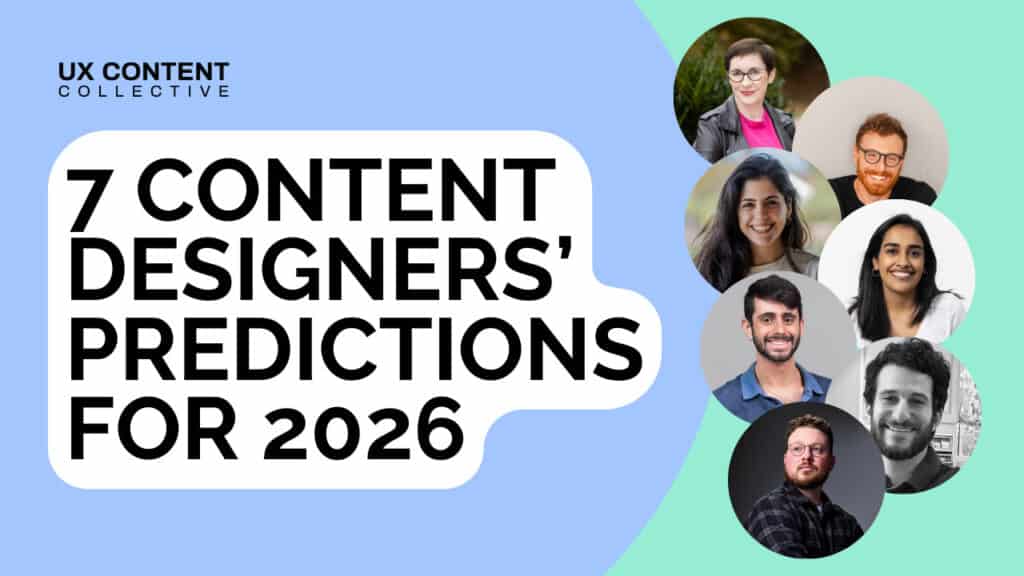
Content design in 2026 is going through a period of incredible change. The good news? This is a time for content designers to take charge and lead. As the year begins, we spoke to 7 different content designers around the world about their thoughts for the coming year, what they think is going to change, and where content designers might be able to wield more influence.
If you’re thinking about a content design career in 2026 – whether you’re a veteran or new to the field – these thoughts should give you some guidance.
“We have an opportunity to be the ones who make AI actually work.” – Chris Greer, Stripe

Chris Greer is a Senior Content Designer for Stripe, where he works on – among other things – content for AI agents. He also recently published a Claude Skill that extracts text from Figma and runs it through UX writing standards. His view is that the principles underpinning content design and AI are more similar than they are different.
AI is a content problem:
“Models can write. They just don’t know who they’re writing for, why, or what rules apply. That’s a content problem.”
Creating content for agents:
“Sarah Winters defined content design as getting the right information to the right people at the right time in the right format. That was a decade ago, written for humans. Read it again with AI agents in mind. Architecting effective agent systems is the same discipline at a different scale: orchestrators routing to sub-agents, each needing precisely the right context. Too little and they hallucinate. Too much and they drown.”
Context engineering:
“Content designers have been practicing context engineering all along. The medium changed; the work didn’t. In 2026, we have an opportunity to be the ones who make AI actually work.”
“We need to ensure a high standard of quality.” – Ron Yakar, Monday.com

Ron Yakar is a Senior UX Writer for monday.com. He pioneered a content system using AI tools that allowed him to manage and critique UX writing among a team of more than 70 designers. His view is that scale is solved, we now need to ensure higher levels of quality as AI becomes a dominant force in design.
Content designers should focus on quality:
“In 2025, we learned that we could empower product designers to write stronger in-product content using AI models trained on our specific voice, terminology, patterns, and so on. In 2026, now that designers are getting used to writing with AI, we’ll need to figure out a way to ensure a high standard of quality.”
“How can we convince designers to maintain a healthy dose of skepticism toward AI-generated content? How can we audit that content? And how can we keep that auditing process efficient?”
“Content designers should create time to experiment.” – Sidika Sehgal, Rubrik

Sidika Sehgal is the Senior UX Writer at Rubrik. She is a leader in the UX writing and content design community in India, and is a proponent of setting aside time to experiment with projects that combine content and AI.
Eliminating surface-level tasks:
“AI is eliminating the surface level content designers do, which is frankly great! Teams no longer need content designers to make sure the sentence is grammatically correct, or whether it follows the company’s writing guidelines. Content designers who focus on conveying the right information at the right touchpoint in the user journey will continue to be valued.”
Set aside time to experiment:
“In big tech, the push to use AI is real. Being open to using AI is non-negotiable. I think companies want to see that you’re experimenting and trying to make the most of it, even if you haven’t found the most mind-blowing use case yet. An application of AI in company A may not work in company B, so this is really the time to play around. Content designers should create time to experiment with it like their career depends on it.”
“Contribute meaningfully to AI.” – Victor Beigelman, Meta

Victor Beigelman is a Senior Content Design Manager at Meta, where he works on AI-related projects. Victor’s view is that content design is in a unique position to lead a lot of the technology evolution related to Large Language Models – but warns content designers that they need to spend more time on creating living content systems.
Content designers will train LLMs:
“In 2026, we’ll see content design capture some portion of two major opportunities presented by the AI boom: 1) a central role in the post-training of frontier LLMs and 2) leading the orchestration of dynamic UX experiences through AI coding and prototyping tools.”
“As language experts and system thinkers, we know our discipline is naturally positioned to excel in this shift, but the extent to which we evolve the discipline in spirit, in practice, and yes, perhaps even in name, depends on what we embrace this year and what we leave behind.”
Living content systems:
“The days of agonizing over content docs for static 2D experiences are over, so CDs should think deeply about what it means to be “AI native” and contribute meaningfully to its definition before non-UX folks do it for us.”
“We’ll become experts in evaluation, workflows, and models.” – Ayelet Kessel, Wix
Ayelet Kessel is a UX Writing Guild Master, Wix Writers Guild. Her view is that content design will look increasingly different based on where you work, but that diversity offers a good base for exploration. Ayelet says you should think carefully about what you’re working on, and how new technology intersects with that discpline.
What are you really learning?

“In 2026, content design will look different for you than it does for me. We’ve always done different things. Some of us were closer to marketing, some closer to product and UX, some closer to engineering. In the next year, we’re all going to have a choice to make – where are we really leaning?”
Are you a maker, or a strategist, or both?
“Those of us who are fans of building stuff might lean into the Creator or Maker roles, becoming a mishmash of product and UX and content all at once. We know that content is at the center of any experience, so you should be well equipped to take this on.”
“Some of us are more techy or systems-oriented, and so our lives will become context engineering, or prompt engineering, or tinkering with all of this to make sense of how AI products are truly built. We’ll become experts in evaluation, workflows and models – and somehow still need to fight for our seat at the table.”
“And then there are also the strategists at heart – those who will supervise everything from a content glance, slightly wider than we’ve gotten used to but content-focused still. Those who create the standards that newly appointed AI-writers will need to behold, set the tone for the entire product, and review and critique the juicy flows.”
“Or you might do all of these things all at once. Who knows? All I know is that it will look different for me, than it does for you. So it’s time to take a deep, thoughtful look at where you’re standing right now, and try to feel where the wind might take you. It’s time to make decision, and start working towards it.”
“More and more content designers are going to become product designers” – Dave Connis, OutSystems
Dave Connis is the Lead Content Designer at OutSystems, where he works on managing design systems. Dave also presents the UX Content Collective workshop on Systems Thinking for UX Content. His view is that increasingly, content designers will need to engage with and ally with technical colleagues. In particular, he says content designers need to pay attention to design systems, governance, and working in code.

Craft is changing:
The idea of “craft” starts visably falling out of favor. Not because it isn’t important, but because it’s not enough of a value prop. Writing a “craftful” onboarding flow is less important than writing one that teaches the user.
Content design becoming more technical:
All design roles are going to turn more technical because of tools like Cursor. Just like CDs can no longer hide behind Figma comments and should be able to put together actual designs, they will need to be able to understand code and the systems that AI can generate. Design and code is blurring. Right now, people are looking for CDs who “understand or are interested in LLMs” but it’s going to turn into more than that. It’s not just that we need to understand AI and LLMs, it’s that we also need to understand code.
Governance and design systems:
“Because of AI, I think taxonomies are going to start being discussed more, which is going to drive more focus on definition on content design teams. You might see more taxonomist type work sneaking into CD descriptions in smaller companies alongside bigger companies hiring more taxonomists outright.”
“The need for good guidelines, systems, processes, gets even more crucial. This is more general but you’re going to see design systems turn a page. I’m not quite sure how yet, but they are more important in the AI era than ever. I think it’s possible that AI might finally force the hand of design system contribution more often. Will content design be taken more seriously in those spaces? Not sure. I hope so.”
“These are more so questions that come out of the bullets above, but will design systems wind up owning taxonomies? They are a cross-functional asset now because of AI. Will content designers realize that APIs are basically source-of-truth places where definition of terms and concepts are already happening and start actively working on those? Will this blur the line between content designers and technical writers?”
Content designers become product designers:
“This is gonna be a hot take, but more and more content designers are going to become product designers. Not because there isn’t a need for content design, but because of all of the reasons above. Once you start living in the systems space, your title begins to blur and you find yourself doing stuff that is beyond “content design” but content-focused design.”
“There are always going to be content designers, but AI is going to create a funnel of content designers doing way more than the deliverables of what is currently content design, accelerating the line blur. I’ve already seen it happening.”
“I think content experts are gaining more respect.” – Erica Jorgensen, author of “Strategic Content Design”
Erica Jorgensen is the author of “Strategic Content Design” with experience across Microsoft, Slack, Remitly, Chewy, and more. Erica’s view is that content designers can’t waste their time being perfectionists, and that the discipline can’t afford to be seen as glorified proofreaders. This time is too important.

The job market is better than you think:
“The job market for content experts is not all gloom and doom! This morning, I had 5 (5!) requests for my portfolio or interview availability this week, though every. single. one. resulted from me working my network or were from long-time contacts. I know this is a sample size of 1, but I’ve also seen updates and heard from other colleagues and connections who are also having success in finding new full-time roles. Huzzah!”
Content professionals can’t be perfectionist:
“Working in and with AI (especially enabling agentic content outputs) means that content pros simply shouldn’t and CAN’T be perfectionists any longer. We don’t control all the outputs, and that requires us to be more chill, if you will. This is a huge leap and adjustment for an industry known for dotting its Is and crossing its Ts, and occasionally freaking out about Oxford commas.”
“Yes, clear, customer-centric content is still important. But the changes in ways of working mean our roles are thankfully shifting AWAY from us often being perceived to be glorified proofreaders (and often bottlenecks). While those labels were unfair and often rooted in a lack of understanding of the scope of content design’s role, I for one am thankful for this shift. Bring on a more relaxed way of working.”
Content governance is paramount:
“While we don’t control the outputs, we DO control much of the inputs, structure, and tagging, and possibly most importantly, the content governance, I think this is resulting in content experts gaining more respect, agency, and impact. Business is paying more attention to our efforts, and in that way, our work is more powerful than the constrained, linear, user journey-focused way of working we’ve been used to until recently.”
“This too is a massive change, but oh, OH how I am here for it. Expanding the impact and influence of content is a very good thing and so long overdue.”

the next step for content designers
Advanced UX Content for Product
A course for content designers and UX writers who need to think beyond screens and operate at product, system, and organisational level.